Last updated: August 6, 2026
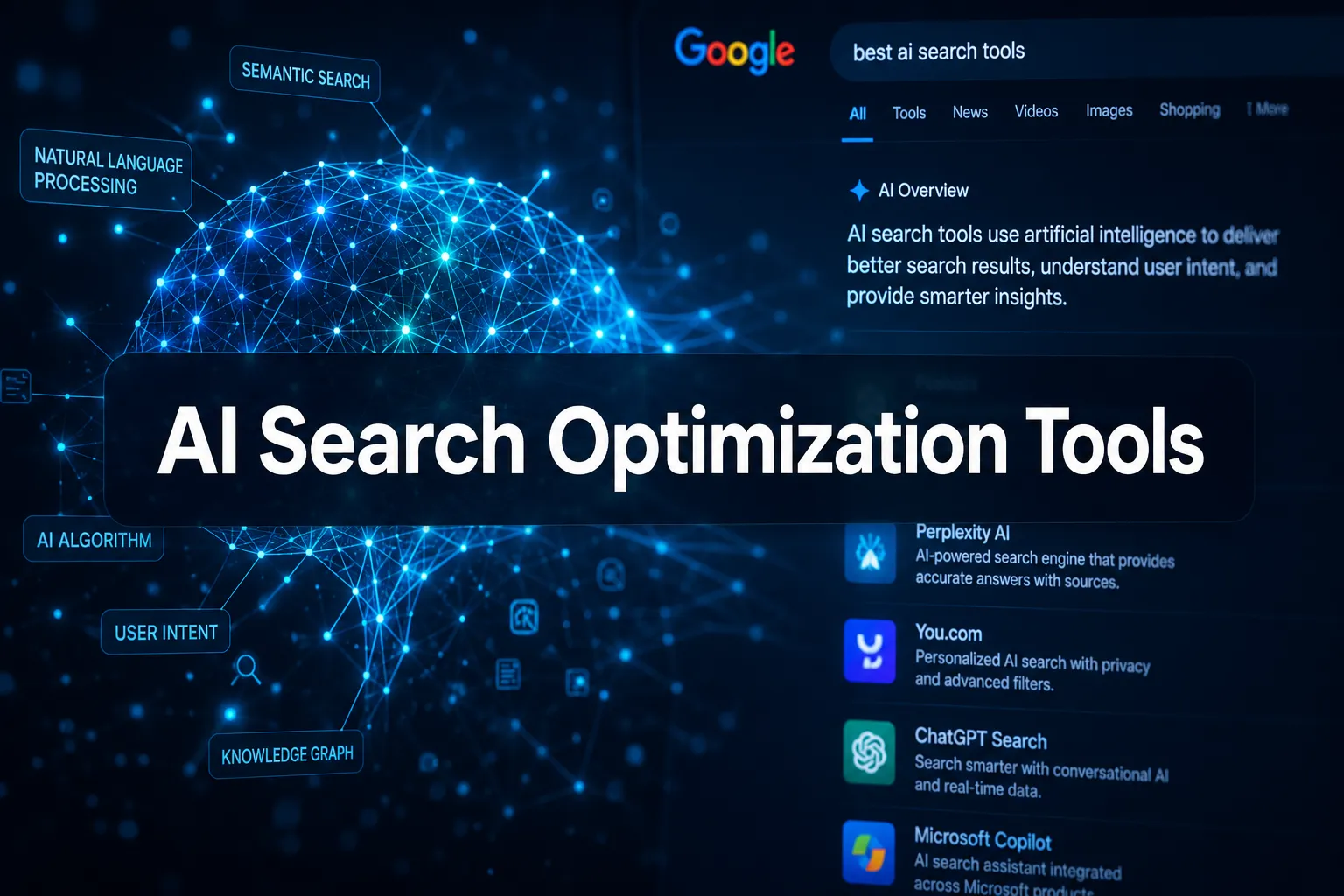
Quick Answer: AI search optimization tools are specialized platforms that help websites structure, format, and position content so that AI-powered search engines, particularly Google’s AI Overviews, are more likely to cite them. In 2026, these tools have become a distinct category separate from traditional SEO software because AI search systems rank and surface content using different signals than classic keyword-based algorithms. Businesses that ignore this shift risk losing organic visibility even when they rank on page one.
Key Takeaways
- AI Overviews pull content from sources that are structured, authoritative, and directly answer specific questions, not just keyword-optimized pages.
- AI search optimization tools analyze your content against the criteria AI systems use to select citations, including entity clarity, answer density, and schema markup.
- Traditional SEO tools focus on rankings; AI search optimization tools focus on citation eligibility within AI-generated responses.
- Getting cited in AI Overviews can drive brand awareness even when click-through rates drop, because your content becomes the answer.
- The biggest mistakes are writing for bots instead of people, ignoring structured data, and publishing vague content that AI systems cannot extract a clear answer from.
- Pricing for AI search optimization platforms ranges from free tiers to enterprise contracts above $500 per month, depending on feature depth and crawl volume.
- Content types that perform best in AI Overviews include FAQ pages, how-to guides, comparison articles, and definition-style content with clear, concise answers.
- Measuring ROI requires tracking AI Overview impressions in Google Search Console alongside branded search volume and direct traffic, not just clicks.
What Are AI Search Optimization Tools and How Do They Work
AI search optimization tools are software platforms designed to help content creators and marketers make their pages more likely to be cited inside AI-generated search responses. They work by auditing content for the signals that large language models and AI search engines use when selecting source material: answer clarity, entity recognition, schema markup, topical authority, and passage-level relevance.
Unlike traditional SEO tools that measure keyword rankings and backlink counts, these platforms evaluate whether a given passage can stand alone as a direct, quotable answer. Most tools in this category include:
- Content gap analysis against AI Overview results for target queries
- Schema and structured data recommendations (FAQ, HowTo, Article markup)
- Entity and topic coverage scoring to ensure completeness
- Passage-level readability checks that flag vague or ambiguous sentences
- Competitor citation tracking to show which sources appear in AI responses for your target keywords
Some platforms also integrate with Google Search Console data to correlate AI Overview impressions with content changes over time.
For a broader look at how AI-enhanced tools are reshaping digital marketing, the Best AI-Enhanced SEO & Design Tools in 2026 guide covers the wider ecosystem well.
How Do AI Overviews Affect SEO and Organic Traffic
AI Overviews, introduced broadly by Google in 2024 and expanded significantly through 2025 and 2026, appear at the top of search results and synthesize answers from multiple sources. Their effect on organic traffic is real but nuanced: click-through rates for informational queries have declined for many sites, while branded awareness and direct traffic have increased for those who are cited.
The key impact points are:
- Zero-click searches increase for simple informational queries, meaning users get answers without visiting any website.
- Citation sites gain authority signals because being named in an AI Overview functions as a high-visibility brand mention.
- Long-tail and complex queries still drive clicks, especially when users want depth beyond what the AI summary provides.
- Sites not cited lose relative visibility even if they maintain their traditional ranking position.
The practical implication: optimizing for AI Overviews is not optional for content-heavy sites in competitive niches. It’s a parallel track to traditional SEO, not a replacement.
AI Search Optimization Tools: The Future of Getting Found in AI Overviews Versus Traditional SEO
Traditional SEO tools and AI search optimization tools solve different problems. Traditional SEO focuses on ranking signals: domain authority, backlink profiles, keyword density, page speed, and Core Web Vitals. AI search optimization focuses on citation eligibility: can an AI system extract a clean, authoritative answer from your content?
| Dimension | Traditional SEO Tools | AI Search Optimization Tools |
|---|---|---|
| Primary goal | Page ranking on SERPs | Citation in AI-generated answers |
| Key signals measured | Backlinks, keywords, speed | Answer clarity, entity coverage, schema |
| Content format focus | Long-form, keyword-rich pages | Self-contained passages, FAQ, definitions |
| Success metric | Ranking position, organic clicks | AI Overview impressions, citation frequency |
Choose traditional SEO tools if your primary goal is driving click-based traffic from transactional or navigational queries. Choose AI search optimization tools if you publish informational content and want to appear inside AI-generated answers. Most serious content operations need both.
For a practical comparison of SEO platforms, the Labrika vs Ahrefs: Uncovering the Best SEO Tool for Your Business breakdown is a useful reference point.
How to Get Your Content Into Google AI Overviews
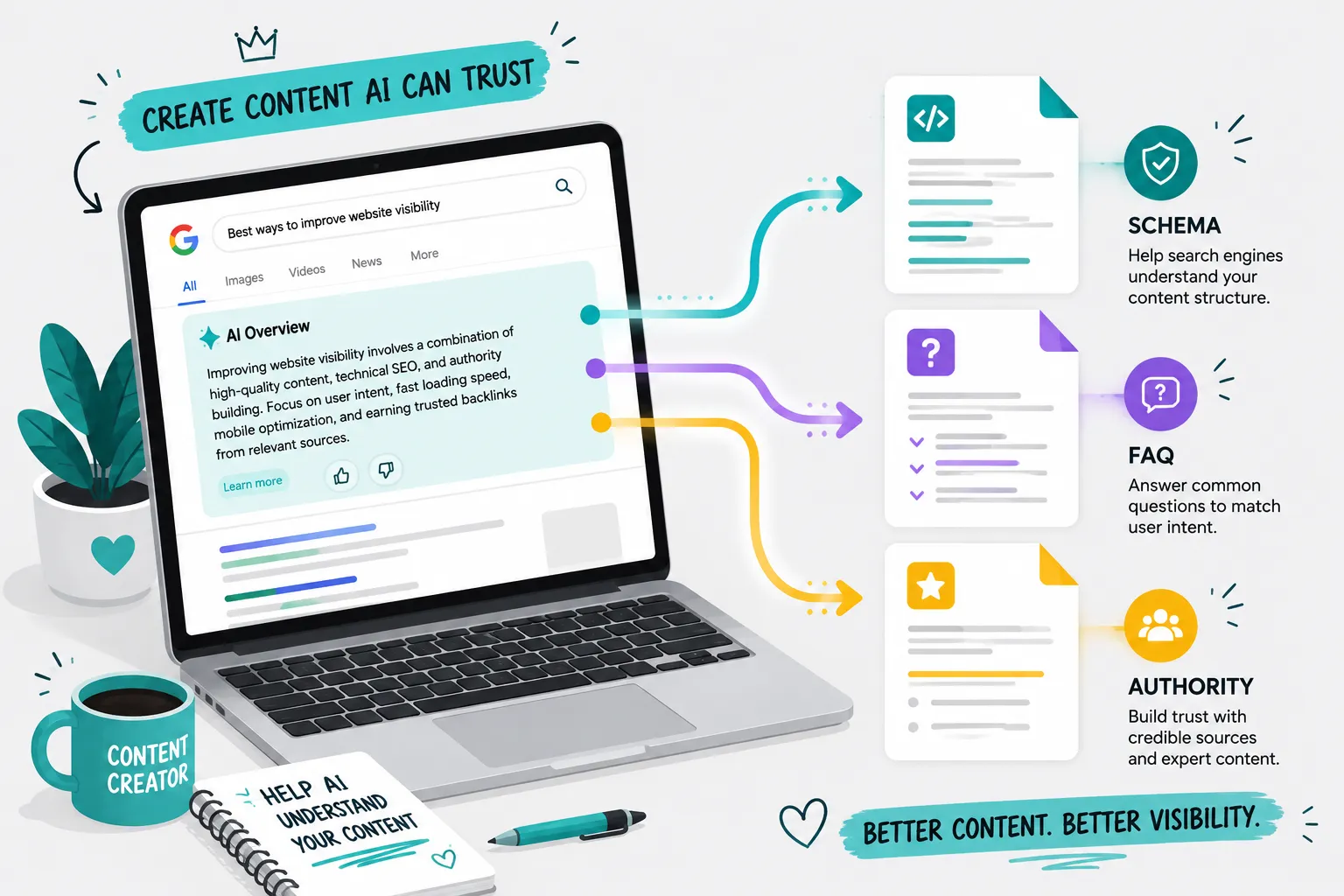
Getting cited in Google AI Overviews requires content that is structured for extraction, not just discovery. Google’s AI systems favor sources that provide direct, verifiable answers in clearly delineated passages.
Step-by-step approach:
- Identify AI Overview-eligible queries. Search your target keywords and note which ones already trigger an AI Overview. These are your priority targets.
- Write a direct answer in the first 2-3 sentences of each section. AI systems pull the clearest, most self-contained passage, so bury-the-lede writing gets ignored.
- Add FAQ schema markup. Pages with FAQ structured data give AI systems a pre-formatted answer block to pull from.
- Cover the full topic cluster. AI Overviews favor pages that answer the main query and its common follow-up questions in one place.
- Cite credible sources. Pages that reference authoritative data are more likely to be treated as authoritative themselves.
- Keep sentences short and specific. Vague, hedging language (“it depends,” “there are many factors”) reduces citation probability.
- Update content regularly. AI systems appear to favor recently updated pages for time-sensitive topics.
What’s the Difference Between AI Overviews and Featured Snippets
AI Overviews and featured snippets are both zero-click features, but they work differently. A featured snippet pulls a single passage from one page and displays it verbatim. An AI Overview synthesizes information from multiple sources into a new, generated response, then cites those sources at the bottom.
This distinction matters for optimization because:
- Featured snippets reward the single best-formatted answer on one page.
- AI Overviews reward topical authority across a content cluster, meaning a site with five strong related pages may be cited even if no single page “wins” a featured snippet.
- Attribution in AI Overviews is less predictable and can shift as Google updates its models.
Optimizing for featured snippets (concise, direct answer blocks) remains a valid strategy and overlaps significantly with AI Overview optimization, but they are not identical targets.
Do I Need AI Search Optimization Tools for My Business
Most businesses that publish content regularly will benefit from at least a basic AI search optimization audit. The question is whether a dedicated tool is worth the cost versus adjusting content practices manually.
You likely need dedicated AI search optimization tools if:
- Your site publishes more than 50 informational articles and you cannot manually audit each one.
- You operate in a competitive niche where AI Overviews appear for most of your target queries.
- You have a team that needs repeatable workflows for content structuring.
You can probably manage without a paid tool if:
- Your site is small (under 20 pages of informational content).
- Your primary traffic comes from transactional queries that rarely trigger AI Overviews.
- You’re willing to manually apply structured data and answer-first formatting using free resources.
For small operations, the Keyword Research Without Tools: 3 Free Data Sources guide shows how to identify query intent without a paid platform, which is a useful starting point before investing in specialized software.
Best AI Search Optimization Tools in 2026
The AI search optimization tools category is still maturing, but several platforms have established clear use cases as of 2026. The best tools combine content auditing, structured data guidance, and AI Overview tracking in one interface.
Leading platforms to evaluate:
- Surfer SEO (with AI Overview mode): Strong on content structure scoring and NLP-based entity coverage. Good for mid-size content teams.
- Clearscope: Focuses on topical completeness and readability. Well-suited for editorial teams that prioritize content quality signals.
- MarketMuse: Deep topic modeling with competitive gap analysis. Better for enterprise content operations.
- Semrush AI Toolkit: Integrates AI Overview tracking with traditional rank monitoring. Useful if you want one platform for both.
- Alli AI: Automates on-page changes including schema injection. Reduces manual implementation time significantly.
For teams building out a full AI SEO stack from scratch, the My 7-Tool AI SEO Stack for New Sites (2026) breakdown is a practical starting point.
How Much Do AI Search Optimization Platforms Cost
Pricing for AI search optimization tools varies widely. Entry-level plans on platforms like Surfer SEO or Clearscope start around $49 to $99 per month for small content volumes. Mid-tier plans covering larger crawl budgets and team collaboration features typically run $150 to $400 per month. Enterprise contracts for platforms like MarketMuse can exceed $500 per month.
Cost factors that affect pricing:
- Number of content briefs or audits per month
- Team seat count
- API access for custom integrations
- AI Overview tracking depth
Free tiers exist on some platforms but are generally limited to a handful of queries per month, which is enough for testing but not for ongoing optimization work.
Can AI Overviews Hurt My Website Traffic
Yes, AI Overviews can reduce click-through rates for informational queries, and this effect is well-documented anecdotally across the SEO community since 2024. When a user gets a complete answer from the AI Overview, they have less reason to click through to any source.
However, the impact is uneven:
- Informational content (definitions, how-tos, explainers) sees the steepest click declines.
- Transactional and commercial content is less affected because users still need to visit a site to make a purchase or booking.
- Sites cited in AI Overviews often see branded search volume and direct traffic increase, partially offsetting click losses.
- Niche and specialized content that goes deeper than an AI Overview can summarize continues to attract clicks from users who want the full detail.
The strategic response is to diversify content goals: optimize for citation to build brand authority, while ensuring transactional pages remain click-worthy.
Common Mistakes When Optimizing for AI Search Results
The most common mistake is treating AI search optimization as a technical checklist rather than a content quality problem. Adding schema markup to thin, vague content does not make it citation-worthy.
Other frequent errors:
- Writing for word count instead of answer density. A 3,000-word article with no clear, extractable answers will be passed over for a 600-word page that directly answers the query.
- Ignoring entity clarity. Using pronouns and vague references (“it,” “they,” “this approach”) instead of named entities makes passages harder for AI systems to interpret.
- Optimizing only the homepage or pillar pages. AI Overviews often cite supporting pages, FAQs, and category pages, not just cornerstone content.
- Neglecting content freshness. Outdated statistics or stale examples reduce credibility signals.
- Over-optimizing for one query. AI systems reward topical breadth, so a page that covers a topic cluster performs better than a page laser-focused on a single keyword.
For a look at how automation can help scale content updates without manual effort, Softr Workflows: AI Automation Without Extra Tools covers relevant workflow approaches.
What Content Types Perform Best in AI Overviews
Definition-style content, FAQ pages, step-by-step guides, and comparison articles consistently appear in AI Overviews more than other formats. These formats share a common trait: they contain self-contained passages that answer a specific question without requiring surrounding context.
Content formats ranked by AI Overview citation frequency (based on observed patterns in 2026):
- FAQ pages with schema markup
- How-to guides with numbered steps
- Definition and explainer articles
- Comparison articles with clear verdict statements
- Listicles with descriptive, specific entries
- Long-form guides with well-structured H2/H3 sections
Content types that rarely appear in AI Overviews:
- Opinion pieces and editorials
- News articles without factual summaries
- Product pages with minimal descriptive content
- Pages with heavy JavaScript rendering that delays content load
How to Measure ROI From AI Search Optimization
Measuring ROI from AI search optimization requires tracking metrics beyond traditional click counts. Google Search Console now reports AI Overview impressions separately from standard impressions for sites enrolled in Search Labs data, which provides the clearest signal of citation frequency.
Key metrics to track:
- AI Overview impressions (via Google Search Console)
- Branded search volume (rising brand searches often correlate with AI Overview citations)
- Direct traffic trends for pages cited in AI Overviews
- Conversion rate on cited pages to assess whether AI-driven visitors convert differently
- Share of voice in AI Overviews for your top 20 target queries (manual check or via tools like Semrush)
ROI calculation is imprecise at this stage because the industry lacks a standardized attribution model for AI Overview citations. A reasonable proxy is to assign a CPM-equivalent value to AI Overview impressions based on what equivalent display advertising would cost for the same audience.
Will AI Search Optimization Tools Replace SEO
AI search optimization tools will not replace traditional SEO; they will become a required layer on top of it. Traditional SEO signals (backlinks, page authority, technical health) remain foundational because AI systems use them to assess source credibility before deciding what to cite.
The more accurate framing: SEO ensures your pages are discoverable and authoritative, while AI search optimization ensures your content is extractable and citation-worthy. Both are necessary. The tools that will dominate by 2027 and beyond are likely to be unified platforms that handle both functions in one workflow, rather than separate tools for each discipline.
For teams already building out their digital tool stack, the Top Digital Marketing Tools & aBlocks WordPress Plugin Insights overview covers complementary platforms worth evaluating alongside AI search optimization software.
AI Search Optimization Tools for Ecommerce Versus Blogs
Ecommerce sites and content blogs have different AI Overview opportunities and therefore need different optimization strategies. For blogs, the priority is getting informational content cited in response to research and how-to queries. For ecommerce, the opportunity lies in product comparison queries, “best X for Y” queries, and category-level informational content that precedes a purchase decision.
For ecommerce sites:
- Optimize category page descriptions to answer “what is the best X” queries directly.
- Add FAQ schema to product pages addressing common pre-purchase questions.
- Create buying guide content that AI systems can cite when users search for product recommendations.
For content blogs:
- Focus on FAQ and definition content first, as these have the highest AI Overview citation rates.
- Build topic clusters rather than isolated articles.
- Use structured data on every informational page, not just pillar content.
The SEO Booster Review: GSC in WordPress, Auto Internal Linking & 404 Fixes covers a tool that handles several of these technical requirements automatically for WordPress-based sites, which covers a large share of both blogs and ecommerce stores.
Frequently Asked Questions
What is an AI Overview in Google Search? An AI Overview is a generated summary that appears at the top of Google search results for many queries. It synthesizes information from multiple web sources and cites them at the bottom of the summary box.
Do I need to pay for AI search optimization tools to get into AI Overviews? No. You can improve your chances of being cited by applying answer-first writing, FAQ schema markup, and clear entity references without any paid tool. Paid tools help you scale and audit these practices across a large content library.
How quickly can I get cited in an AI Overview after optimizing my content? There is no guaranteed timeline. Some pages see AI Overview citations within weeks of being updated; others take months. Freshness, topical authority, and the competitiveness of the query all affect speed.
Does having a high domain authority guarantee AI Overview citations? No. Domain authority helps, but AI systems also cite smaller, newer sites when those sites have the clearest, most direct answer to a specific query. Content quality and structure matter more than domain authority for AI Overview eligibility.
Can I see which of my pages are cited in AI Overviews? Google Search Console shows AI Overview impression data for enrolled users. For a broader view across competitors, tools like Semrush and BrightEdge offer AI Overview tracking features.
Is AI search optimization the same as generative engine optimization (GEO)? They overlap significantly. Generative engine optimization (GEO) is a broader term that covers optimization for all AI-generated responses, including ChatGPT, Perplexity, and Google AI Overviews. AI search optimization is often used specifically in the context of Google’s search product.
What schema markup types matter most for AI Overviews? FAQ schema, HowTo schema, and Article schema are the most consistently impactful. These give AI systems pre-structured answer blocks to work with.
Will AI Overviews eventually replace the standard search results page? Google has indicated that AI Overviews and traditional results will coexist. Standard results remain important for transactional, navigational, and complex research queries where users want to choose their source.
How do I know if an AI Overview is hurting my traffic? Compare your AI Overview impression count in Search Console against your click-through rate for the same queries over time. A rising impression count with a falling CTR is the clearest signal that AI Overviews are intercepting traffic.
Are there free AI search optimization tools available in 2026? Several tools offer free tiers, including Semrush’s free plan and Google’s own Search Console, which now includes AI Overview data. Fully featured free tools are rare, but free tiers are sufficient for auditing a small site.
Conclusion
AI search optimization tools represent a necessary evolution for anyone serious about content visibility in 2026 and beyond. The core insight is straightforward: AI systems do not rank pages the way traditional search algorithms do. They extract answers, and only content structured to be extracted gets cited.
Actionable next steps:
- Run a manual audit of your top 10 informational pages. Check whether each section opens with a direct, self-contained answer to a specific question.
- Add FAQ schema markup to every informational page on your site. This is the single highest-leverage technical change for AI Overview eligibility.
- Search your 20 most important target keywords and note which ones trigger AI Overviews. Prioritize those pages for optimization first.
- Set up AI Overview impression tracking in Google Search Console so you have a baseline before making changes.
- Evaluate one AI search optimization tool on a free trial, focusing on content gap analysis and entity coverage scoring for your top pages.
The sites that will dominate AI search results over the next two to three years are not necessarily the ones with the most backlinks or the longest articles. They are the ones whose content is clear, structured, and genuinely useful enough that an AI system trusts it as a source. That standard is achievable for any site willing to prioritize content quality over content volume.