Last updated: August 6, 2026
Quick Answer
Optimizing for AI search means structuring content so that AI-powered tools like ChatGPT, Perplexity, and Google’s AI Mode can extract, cite, and surface it in generated answers. The core difference from traditional SEO is that AI engines reward clear, self-contained, factually dense writing over keyword-heavy pages built for click-through. Start by writing direct answers at the top of every section, using structured formatting, and earning mentions on authoritative external sources.
Key Takeaways
- AI search engines pull citations from content that answers questions directly and completely in a single passage.
- Traditional keyword density tactics matter far less than semantic clarity, factual accuracy, and structured formatting.
- Google AI Mode, Perplexity, and ChatGPT Browse each use different ranking signals, but all favor authoritative, well-organized content.
- You do not need a separate keyword list for AI search, but you do need to phrase content around natural questions, not just head terms.
- Small businesses and niche sites can compete in AI search by owning specific, narrow topics with deep, accurate coverage.
- Traffic from AI search can offset Google click losses, but only if your site is cited, not just crawled.
- Most sites see early citation signals within 4 to 12 weeks of targeted AI search optimization.
- The biggest mistakes are writing for bots instead of readers, ignoring structured data, and publishing thin pages that lack verifiable detail.
What Is SEO for AI Search and How Is It Different from Traditional SEO
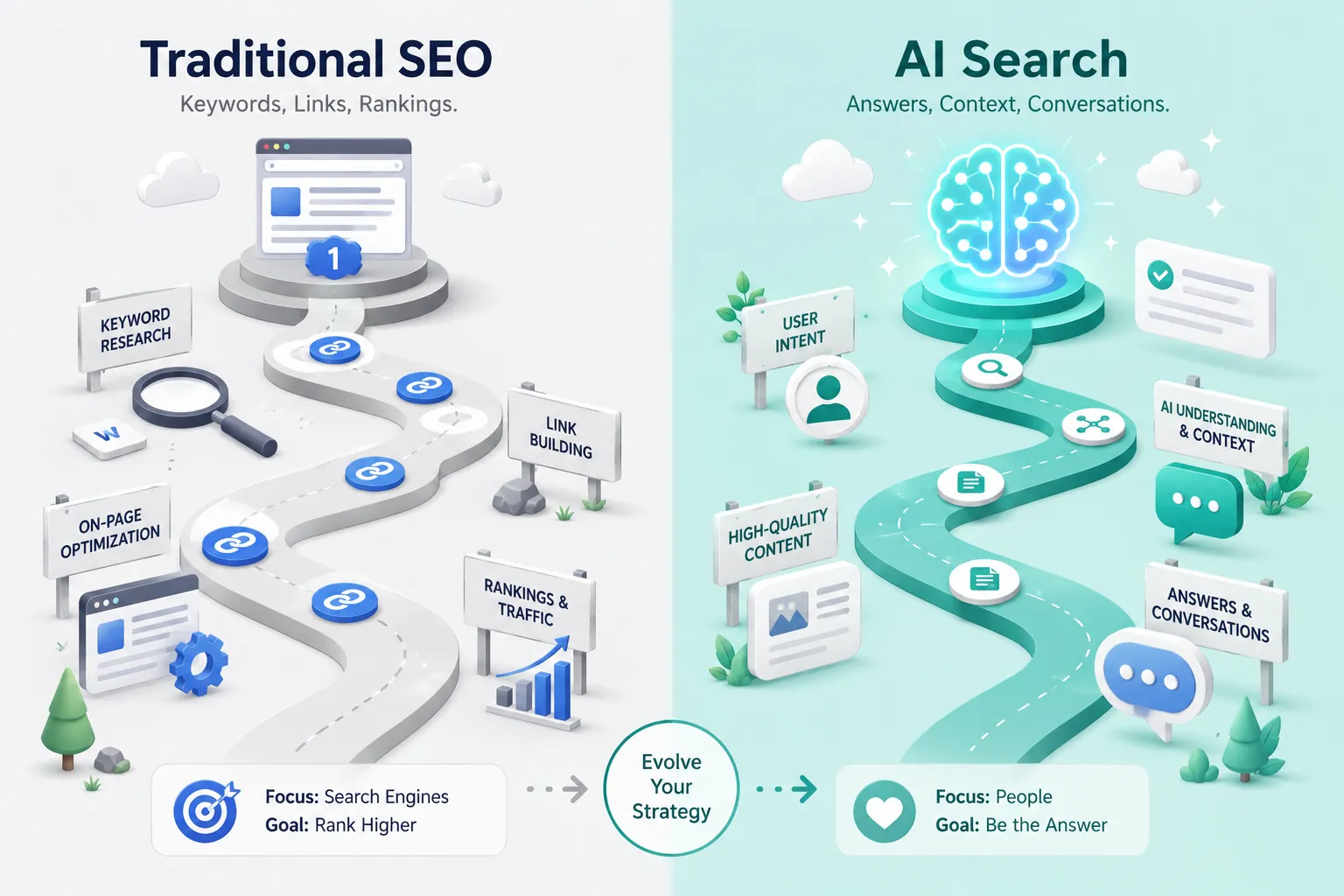
SEO for AI Search refers to the practice of structuring, formatting, and positioning content so that AI-powered answer engines can extract it, trust it, and cite it in generated responses. Unlike traditional SEO, which optimizes for ranked blue links, AI search optimization targets the generated answer itself, the passage a model quotes or summarizes before a user ever clicks.
Traditional SEO rewards pages that rank for keywords through backlinks, on-page optimization, and technical health. AI search rewards pages that contain the clearest, most self-contained answer to a question, regardless of domain authority alone.
Key differences at a glance:
| Factor | Traditional SEO | AI Search SEO |
|---|---|---|
| Primary goal | Rank in blue-link results | Get cited in AI-generated answers |
| Content format | Keyword-optimized long-form | Direct-answer passages, structured sections |
| Authority signals | Backlinks, domain rating | Source credibility, factual accuracy, citations |
| User behavior | Click-through to site | Answer consumed in-engine, optional click |
| Measurement | Impressions, rankings, CTR | Citation frequency, brand mentions, referral traffic |
How AI Search Engines Like Perplexity and ChatGPT Rank Content Differently
Perplexity, ChatGPT Browse, and Google AI Mode do not use a single unified ranking algorithm. Each pulls from its own index or retrieval layer, but all share a preference for content that is factually grounded, clearly attributed, and structured for extraction.
Perplexity relies heavily on real-time web retrieval and tends to cite pages that answer the query in the first 100 to 200 words. ChatGPT Browse (when active) favors pages with clean HTML structure, minimal ad clutter, and clear authorship signals. Google AI Mode draws from Google’s existing index but weights structured data, E-E-A-T signals, and passage-level relevance more heavily than standard rankings.
What all three share:
- A preference for direct answers near the top of the page
- Sensitivity to factual accuracy and source credibility
- Favor for pages with clean, crawlable markup
- Tendency to cite pages that are already well-linked and referenced elsewhere
For a deeper look at SEO tooling that surfaces these signals, see this Labrika SEO review and how to use it for an overview of an audit tool that tracks on-page optimization factors relevant to AI-era search.
What Are the Best Practices for Optimizing Content for AI Search Results
The best practices for AI search optimization center on three pillars: answer-first writing, structured formatting, and verifiable authority. Pages that open with a direct answer, use clear headings, and back claims with named sources are consistently more likely to be cited in AI-generated responses.
Actionable best practices:
- Lead with the answer. Place the direct response to the page’s core question in the first paragraph, not after a lengthy introduction.
- Use question-based headings. Phrase H2s and H3s as natural questions your audience would type or speak.
- Write self-contained passages. Each section should make sense if lifted out of context. Avoid vague pronouns like “this” or “it” without a clear referent.
- Add structured data. FAQ schema, HowTo schema, and Article schema all help AI engines parse your content’s intent.
- Cite verifiable sources. Named sources and publication years increase the credibility score AI models assign to a passage.
- Keep paragraphs short. Aim for 3 to 5 sentences per paragraph. Dense walls of text are harder for retrieval models to parse.
- Use tables and lists for comparisons. Structured data formats are easier for AI to extract than prose comparisons.
For WordPress users, the SEO Booster tool with auto internal linking and GSC integration can help automate some of the structural improvements that support AI search visibility.
Can I Use the Same Keywords for AI Search as I Do for Google
Yes, largely, but the application differs. The same topic clusters and semantic themes that perform well in Google also signal relevance to AI engines. The key shift is moving from targeting head keywords to covering the full question landscape around a topic.
AI search engines process natural language queries, not keyword strings. A page optimized for “best project management tools” should also cover “which project management tool is best for small teams,” “how to choose project management software,” and related follow-up questions. This is sometimes called fan-out coverage, and it is the single biggest structural change most sites need to make.
Choose question-based phrasing if: your content answers a specific who, what, when, why, or how. Stick with head terms if: you are targeting navigational or transactional queries where the user wants a specific brand or product page.
If you want to build a keyword strategy without expensive tools, see keyword research using free data sources for a practical method that works for AI-era content planning.
Does SEO for AI Search Cost More Than Regular SEO
AI search optimization does not require a separate budget line, but it does require a shift in where time and money are spent. Less budget goes toward link-building campaigns; more goes toward content quality, structured data implementation, and topical authority development.
For most sites, the incremental cost is minimal if they already produce quality content. The main investment is in auditing existing pages to add direct-answer openings, restructuring headings, and adding schema markup. Agencies and freelancers who specialize in content strategy are increasingly offering AI search audits as a standalone service, typically priced similarly to a standard technical SEO audit.
How Do I Know If My Site Is Being Indexed by AI Search Engines
There is no single “AI search index” to check, since each engine maintains its own crawl. For Google AI Mode, standard Google Search Console data applies. If your pages are indexed in Google, they are eligible for AI Mode citations. For Perplexity and ChatGPT Browse, you can test directly by asking those tools questions your content answers and checking whether your domain appears in the cited sources.
Quick checks:
- Search your brand name or a unique phrase from your content in Perplexity and ChatGPT Browse.
- Use Google Search Console to confirm pages are indexed and have no crawl errors.
- Check your robots.txt to ensure you have not accidentally blocked AI crawlers (GPTBot, PerplexityBot, ClaudeBot).
- Monitor referral traffic in your analytics for visits from ai.perplexity.ai or chatgpt.com.
What Happens to My Traffic If AI Search Takes Over from Google
Zero-click behavior is already increasing across all major search engines, and AI-generated answers accelerate that trend. Sites that are cited in AI answers can maintain or grow brand visibility even as raw click volume from organic results declines. Sites that are not cited risk significant traffic loss.
The practical response is to build for citation, not just for clicks. That means becoming the authoritative source on a specific topic cluster, earning mentions on other sites, and ensuring your content is structured so AI engines can extract and attribute it accurately.
Which AI Search Engines Should I Optimize For First
Start with Google AI Mode, then Perplexity. Google AI Mode reaches the largest audience by a wide margin and is built on the same signals as traditional Google SEO, so improvements compound. Perplexity is the fastest-growing independent AI search engine as of 2026 and is particularly active in research and professional queries.
ChatGPT Browse matters for brand visibility, especially in B2B and tech sectors. Microsoft Copilot (powered by Bing) is worth considering for markets where Bing has stronger penetration, particularly enterprise and education.
Prioritization guide:
- General consumer traffic: Google AI Mode first
- Research and professional queries: Perplexity
- Brand awareness in tech/B2B: ChatGPT Browse
- Enterprise/education: Microsoft Copilot
What Is the Difference Between Optimizing for SGE Versus Other AI Search Tools
Google’s Search Generative Experience (SGE) has evolved into what Google now calls AI Mode as of 2026. The optimization principles are the same as for other AI tools, but Google AI Mode weighs E-E-A-T (Experience, Expertise, Authoritativeness, Trustworthiness) signals more heavily than independent tools like Perplexity, which relies more on real-time retrieval and source diversity.
For Google AI Mode, author credentials, named sources, and established domain authority carry more weight. For Perplexity, recency, direct answers, and clear attribution matter most. The safest strategy is to optimize for both simultaneously, since the content qualities they reward largely overlap.
Do I Need to Change My Content Strategy for AI Search Optimization
Yes, but the changes are evolutionary, not a complete rebuild. The core shift is from writing for keyword rankings to writing for answer extraction. That means covering topics comprehensively in a single URL, leading every section with a direct answer, and structuring content so individual passages are quoteable and self-contained.
Content strategies that relied on thin, keyword-stuffed pages will see the steepest decline. Strategies built on genuine topical depth, clear writing, and factual accuracy will transition most smoothly.
For businesses managing content alongside client relationships, tools like the AgencyJoy platform for freelancers and agencies can help streamline content workflows as AI search optimization demands increase.
How Long Does It Take to See Results from AI Search Optimization
Most sites see early citation signals within 4 to 12 weeks of making targeted improvements to existing high-traffic pages. Full topical authority development, where a site is consistently cited across a topic cluster, typically takes 3 to 6 months.
The fastest wins come from optimizing pages that already rank on page one of Google but lack direct-answer openings or structured formatting. These pages are already trusted by Google’s index, so adding AI-friendly structure can trigger citations relatively quickly.
Are There Common Mistakes People Make When Optimizing for AI Search
The most common mistake is treating AI search optimization as a separate, parallel strategy rather than an evolution of existing content quality practices. Other frequent errors include:
- Blocking AI crawlers in robots.txt without realizing it cuts off citation eligibility entirely.
- Writing for bots instead of readers, producing robotic, over-structured content that reads poorly and gets ignored.
- Ignoring existing content, focusing only on new pages while older, high-authority pages sit unoptimized.
- Neglecting structured data, missing the schema markup that helps AI engines classify and extract content accurately.
- Over-optimizing for one engine while ignoring the others, since citation patterns differ across platforms.
Do AI Search Engines Favor Certain Content Formats
Yes. AI engines consistently favor content that uses clear headings, short paragraphs, bullet lists for multi-item answers, and tables for comparisons. FAQ sections are particularly effective because they mirror the question-answer format AI engines use to generate responses.
Long-form content outperforms short content when it covers a topic comprehensively, but length alone is not the signal. A 600-word page that answers a question completely will outperform a 3,000-word page that buries the answer in filler.
Formats that perform well in AI citations:
- FAQ sections with direct, standalone answers
- Step-by-step numbered lists
- Comparison tables with clear labels
- Definition blocks at the start of sections
- “Quick Answer” summaries at the top of pages
How Do I Optimize for AI Search If I Run a Small Business or Niche Site
Small businesses and niche sites have a genuine structural advantage in AI search: they can own a narrow topic completely. AI engines favor the most authoritative source on a specific question, and a niche site that covers one topic in depth often outperforms a large generalist site on that specific query.
The strategy is to identify the 10 to 20 core questions your audience asks, build a dedicated page for each, and link them together as a topic cluster. Each page should open with a direct answer, use structured formatting, and cite any claims with named sources.
For small businesses building an online presence across multiple channels, understanding AI-powered solutions for digital engagement can complement an AI search strategy by improving how your brand appears across AI-driven platforms.
FAQ
What is the single most important change I can make for AI search optimization? Add a direct, 2 to 4 sentence answer at the top of every page and every major section. AI engines extract the clearest available answer to a query, and placing it prominently is the fastest way to become a cited source.
Does domain authority still matter for AI search? Yes, but it is weighted differently. High domain authority helps with Google AI Mode, which draws from the existing Google index. For Perplexity and ChatGPT Browse, source credibility and content accuracy matter more than raw domain metrics.
Should I add FAQ schema to every page? Add FAQ schema to any page that contains question-and-answer content. It is not necessary on product pages or purely navigational pages, but it is highly effective on informational and how-to content.
Can AI search send direct traffic to my site? Yes. When an AI engine cites your page, users can click through to the source. Perplexity in particular shows source links prominently, and referral traffic from ai.perplexity.ai is measurable in standard analytics platforms.
Is AI search optimization the same as GEO (Generative Engine Optimization)? They are used interchangeably in most contexts. GEO is the term some researchers use specifically for optimizing content to appear in generative AI outputs. The practical techniques are identical to what this guide covers under AI search optimization.
Do I need to rewrite all my existing content? No. Prioritize pages that already receive organic traffic and have strong topical relevance. Add direct-answer openings, restructure headings as questions, and add schema markup. Full rewrites are rarely necessary.
How do I block specific AI crawlers if I want to? Add disallow rules to your robots.txt file using the crawler’s user-agent name. For example, GPTBot for ChatGPT, PerplexityBot for Perplexity, and ClaudeBot for Anthropic’s Claude. Be aware that blocking these crawlers removes your content from citation eligibility on those platforms.
Does social media presence affect AI search citations? Indirectly. Social signals are not direct ranking factors for AI search, but content that earns links and mentions because of social distribution increases the external authority signals that AI engines use to evaluate credibility.
What tools can I use to track AI search citations? As of 2026, dedicated AI citation tracking tools are emerging but not yet standardized. The most reliable method is manually querying Perplexity and ChatGPT with your target questions and monitoring referral traffic from AI engine domains in your analytics platform.
Is video content indexed by AI search engines? Text transcripts and captions associated with video content can be indexed and cited. Pure video without accompanying text is generally not extractable by current AI retrieval systems.
Conclusion
The shift to AI-powered search is not a future event to prepare for; it is the current reality shaping how content gets discovered and consumed in 2026. The complete guide to SEO for AI Search covered here reduces to a few durable principles: write direct answers, structure content for extraction, cover topics completely, and earn credibility through accuracy and attribution.
Actionable next steps:
- Audit your top 10 organic pages and add a direct-answer opening paragraph to each.
- Restructure H2 headings as natural questions your audience asks.
- Add FAQ schema to all informational pages.
- Check your robots.txt to confirm AI crawlers are not blocked.
- Set up referral traffic tracking for AI engine domains in your analytics tool.
- Build out topic clusters by identifying the follow-up questions around your core pages and creating dedicated content for each.
Consistent application of these steps, starting with existing high-traffic pages, is the fastest path to measurable AI search citation and the traffic that follows.